
Beyond Job Titles: Orchestrating People, Tech, and Purpose
We are living in an in-between hour. The habits of yesterday have not fully faded, yet the contours of tomorrow are already visible. In this liminal space, the idea of the “modern worker” is being rewritten. Careers are no longer bound by clear labels or flow in a linear way. Nowadays, it doesn’t matter what someone is called; what counts is what they can accomplish, how fast they can pick things up, and how much you can contribute. Skills, judgment, and adaptability have become more important than roles, which are now only for a short.
This shift is not philosophical alone. It is structural, measurable, and increasingly visible across regions. Organizations are struggling to keep pace with the demands of a fast-evolving economy, particularly as skill requirements change faster than traditional role definitions. More than three quarters of Asia Pacific firms said they had trouble finding skilled employees in the second quarter of 2025, with the most severe shortages occurring in engineering, data, and technology roles. Local workforce evaluations, such as WilsonHCG’s, also show a clear trend away from hiring based on credentials and toward skills-based analysis. In such a context, rigid titles often restrict more than they clarify. What organizations increasingly seek are individuals who can cross boundaries, absorb complexity, and reconfigure themselves as work itself continues to change shape.
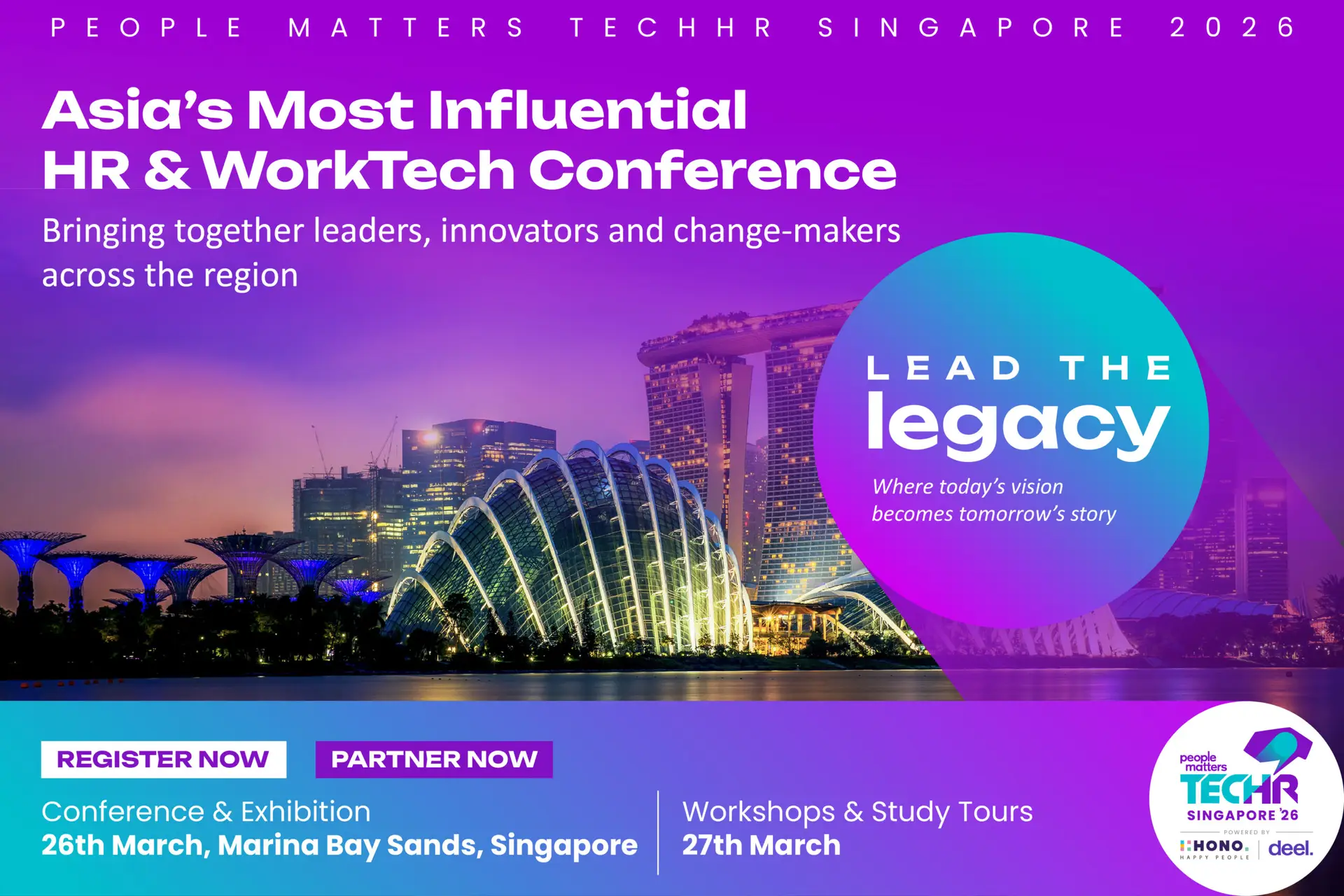
The conceptual foundation of People Matters TechHR Singapore 2026 is this changing reality. The conference presents change as a living system to recognize rather than a disruption to control under the heading of person-centered progress. The event asks executives to ponder about how talent, technology, and intent can all be aligned into a rational rhythm, drawing influence from the Year of the Horse, a sign of movement and drive. Growth, in this sense, is not forced through acceleration alone. It is orchestrated through alignment.
One critical dimension of this orchestration lies in how technology is experienced in everyday work. For much of the past, digital systems were designed to monitor, standardize, and control performance. As blended and digitally controlled workplaces become more common, that approach appears to have grown increasingly in step with how people actually work these days. In 2026, leadership is less about exercising power and more about creating a setting promoting involvement, trust, and creativity. Instead of asking whether tools are powerful, the main question at the moment is whether they are helpful, compassionate, and intuitive. Technology becomes an amplification of involvement rather than a drain on attention when it assists people focus, reduces stress, and makes tasks easier rather than harder. Structured strategy documents usually have less of any effect on culture than daily interactions between people and systems.
Realizing that no business can successfully manage this environment on its own is equally important. As work surpasses institutional and national boundaries, governments, educators, startups, and platform providers have joined the ecosystems where talent systems are developing. The degree of collaboration allows companies to better spread risk, speed up innovation, and anticipate future skill requirements. When evaluating limitations as a whole, can be transformed into shared capacity. Culture serves as a unifying factor in these ecosystems by fostering inclusivity, trust, and shared responsibility among different stakeholders.
The sustainability of change turns out by the relationship between technology and its users. Digital transformation is better understood as a shared movement, despite the fact that it is frequently characterized as a race to keep up. Frustration increases when instruments are developed without consideration for human limitations. Without support, curiosity often turns into exhaustion. Businesses that promote experimentation are the ones that endure, develop competence with new tools, and maintain an understanding of fundamentally human qualities including empathy, moral discernment, and creativity. According to this principle, skills shape careers and learning pathways rather than static roles.
We stand, then, at a quiet threshold. The future of work does not demand haste so much as attentiveness. It asks leaders to notice how tools shape daily experience, how collaboration now extends beyond walls and titles, and how growth emerges when speed is balanced with meaning. As the horizon approaches, the choice becomes clear. We have two options: either we learn to command a more human symphony of work, or we cling to decaying frameworks. The question is not whether change is on the horizon, but whether we are ready to steer it with purpose.